Everything you need to know about shaped wedding bands

This is a simple guide to Shaped wedding bands, also known as crown rings or curved wedding rings. Why you might choose them, their pros and cons and some examples of how they can pair with engagement rings
Why choose a curved band?
Often engagement rings are designed with the gemstones set high above the band, so that a straight wedding ring can slide underneath the setting. These type of engagement rings on my site are described as wed fit.
But for many vintage and unusually shaped engagement rings with a lower stone setting, straight wedding bands don’t sit perfectly next to them leaving visible gaps between the two rings. A wedding ring that hugs the contours of the engagement ring, leaving no gaps solves this problem. Spaces between the two rings are not a problem, it’s simply a question of whether the aesthetics bother you. Plus, the combination of two or more rings stacked together working in harmony can create a unique statement
Pros and cons
The one point I always ask clients to consider is what the wedding band will look like when worn on its own. This is particularly important for professions such as nurses, where wearing an engagement ring. Isn’t practical.
An irregular shape is not usually a big deal, as a ring with a curve, or gentle wave will look great when worn without its partner ring. However for more unusual shapes it is worth weighing up the pros and cons, and how much small gaps between the two rings will bother you, compared to an unusual shaped wedding band when worn on its own.
Also keep I mind that if the ring should ever need to be resized, a shaped band will always be a little more tricky to adjust than a simple straight ring.
Common styles
The Wish bone shape is very popular, and very adaptable. It suits all styles of engagement ring. And looks very elegant when worn alone.
Curved
A gentle wave is often all that’s needed. A Subtle curve follows the line of the engagement ring.
Shaped
Following the shape of the engagement ring more closely than the curved option. This is the style if you want the wedding band to follow the contours of the engagement ring exactly.
Gap ring
Technically a straight band, this style offers an alternative solution. The gap allowing the engagement rings central gemstone space. This style often uses a gem at each end, which can frame the centre stone nicely. But a word of caution, these rings can loose their shape, opening wider, so keep in mind the ring will need a thicker width, for strength.
How are they made
A shaped ring is usually a completely bespoke creation. When making them I will ask to borrow the engagement ring, so i can use it as a guide, often carving the shape from wax, or bending the metal wire by hand. The wedding band is constantly being held up to the engagement ring to ensure a perfect fit.
What are Salt and Pepper Diamonds?

The Ondine engagement ring, set with a round salt and pepper diamond.
Over the past few years salt and pepper diamonds have grown in popularity, they are now one of the gemstones I work with most often, and some are the centrepiece in some of my most popular engagement rings. But what are they and what gives them such a unique beauty?
How Do Salt and Pepper Diamonds Differ From White Diamonds?
Salt and Pepper diamonds are formed like any other diamond, deep in the earths mantle. During this process extreme pressure and heat can cause small internal flaws in the diamonds known as inclusions, and the presence of minerals, gases or radiation can add colour to the stones.
High quality white diamonds which are traditionally the most sought after have an absence of any colour, and very few small inclusions. To learn more about what makes white diamonds so special and how they are graded view my guide to the 4Cs.
However more and more of us are now drawn to unique stones, whose inclusions crackles and colour variations should be celebrated for their beauty rather than seen only as imperfections.
How Did they Get Their Name?
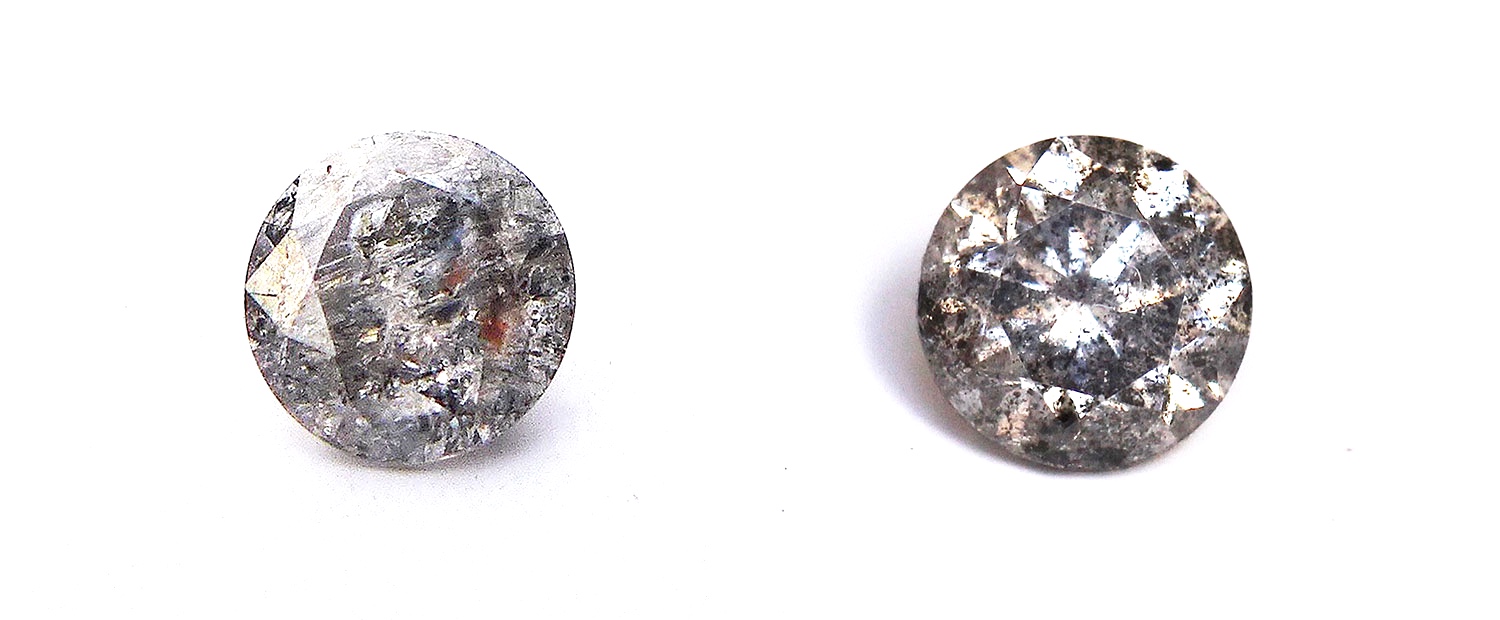
Salt and Pepper diamonds are named because of highly visible white (salt) and black (pepper) inclusions, no two stones will have the same unique markings. There is a huge variety to the patterns, from speckled to swirling cloud like formations.
Because of all these inclusions they don’t have the bright sparkle of a white diamond, and this contrast means the two styles compliment one another when worn side by side, for instance two smaller white diamonds either side of a larger salt and pepper..
What Do they Cost?
Nicknames such as salt and pepper, rustic, natural and rough are applied to diamonds that contain a high proportion of one of a kind natural flaws, with colours ranging from light grey to dusky pink to terracotta reds. As they are not as rare as the traditional white diamonds these heavily included stones are more affordable, so you can choose a bigger stone for your budget. As I describe in the blog post about grading white diamonds there are many different factors that effect a white diamonds value, Salt and pepper diamonds are not graded on colour in the same way, but the skill with which the stone has been cut does effect price. So its impossible to give a direct comparison. However for designs with larger “statement” stones, top quality white diamonds can cost tens of thousands of pounds. A Rustic diamond whilst still valuable can be a fraction of this total.
I would always advise choosing a gemstone for qualities such as colour and shape, rather than placing more importance on size alone
Alternative Engagement Rings
The growing popularity of alternative salt and pepper diamond engagement rings represents a new interpretation of love and beauty. One that places more value on individual and unique qualities. Making them the (Im)perfect symbol of a modern romance.




Recent Wedding Rings
Some of my favourite wedding rings from spring 2018
Spring has been really busy this year with preparations for the wedding season in full flow. So I thought I'd share a few of my favourite wedding ring designs from the past couple of months.
Really the best thing about a piece of handmade jewellery is that you can make tweaks to the design so it suits you perfectly. All of these rings have some small unique details which make them personal to their owner.

Bespoke white gold band with a scattering of aquamarine and diamonds.

Faceted band with bespoke triangular engraving


Diamond eternity and yellow gold band
Child Refugee Crisis Appeal
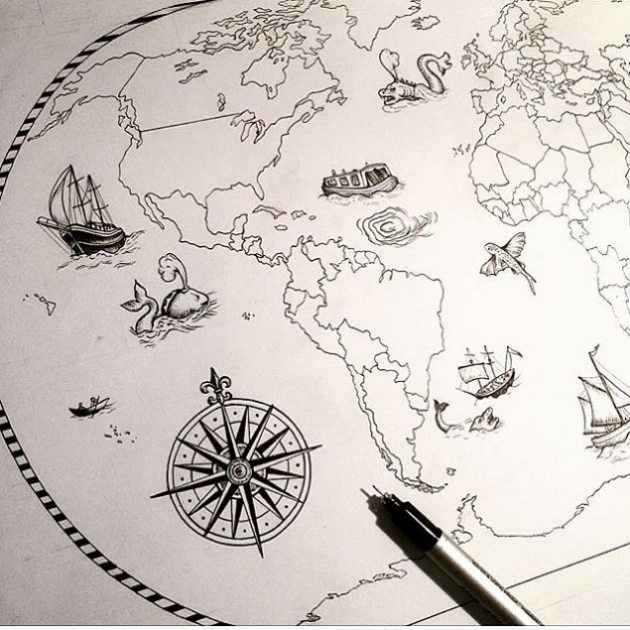
World map print sold with all profits going to Save the Childrens Child Refugee Crisis Appeal.
A little while ago I commissioned illustrator Holly Watts to draw a world map to depict the parts of the world the materials I use originate. The finished design is beautiful and is now available to buy in a limited edition print. All profits will be donated to Save the Children's Child Refugee Crisis Appeal. You can buy it via Holly's Etsy shop.
Only £30 Printed on A2 Textured Fine Art Paper, 285gsm, each print is signed and numbered.
Save The Children provide support around the world. The money donated will help to provide warm clothes, food, emotional support and education to children forced from their homes.
To find out more about this amazing cause, please visit -
www.savethechildren.org.uk/about-us/emergencies/child-refugee-crisis

Work in progress. Engagement ring designs
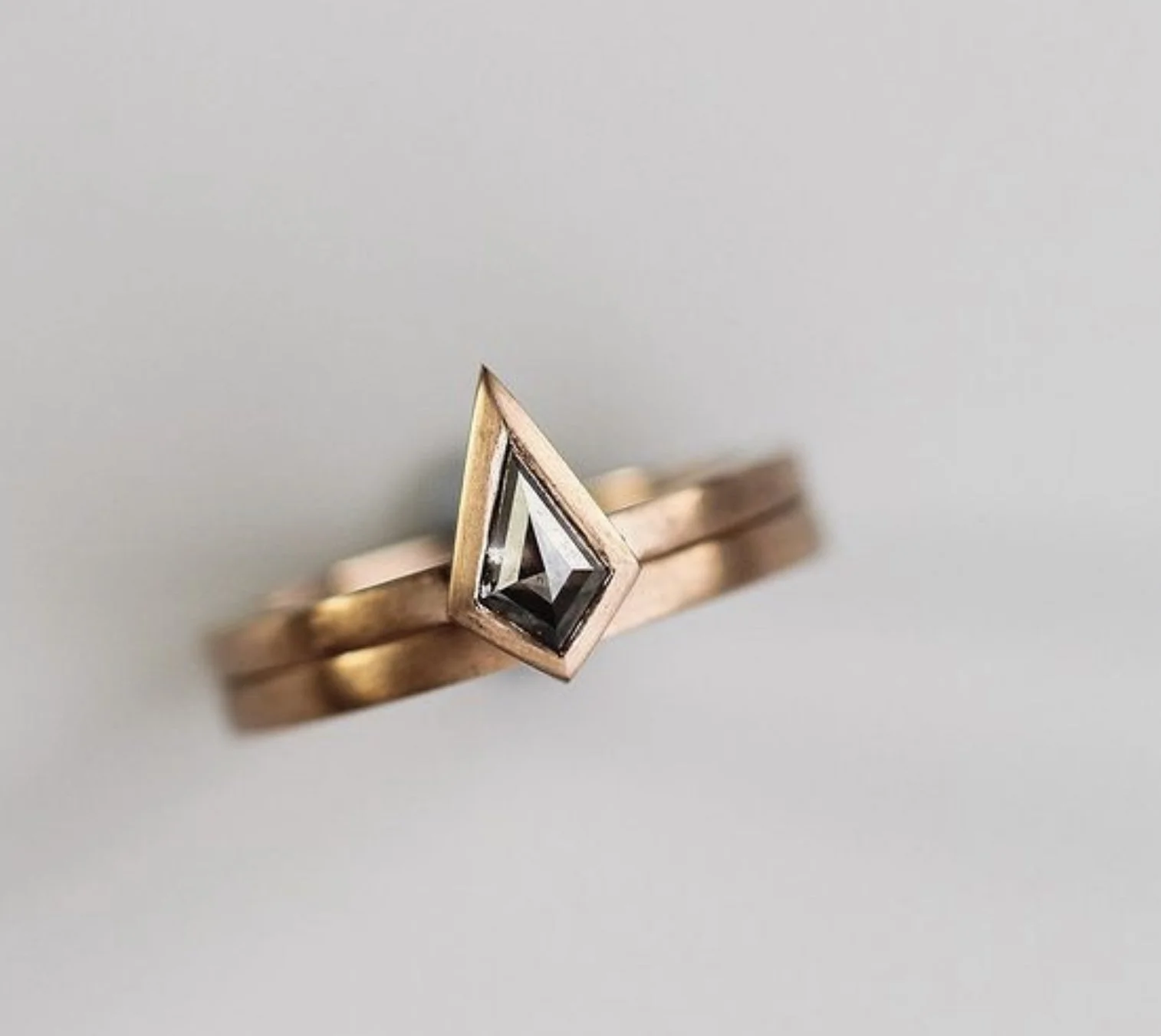
A sneak peek of upcoming deigns for the "Goddess" collection of engagement rings. Featuring hand engraved details.
Over the past six months I've been experimenting with ideas for a new collection of engagement rings.
I wanted the bands to be delicate and to find a balance between the precision of geometric shapes with the warmth of a handmade piece.
Now coming near to completion here is a sneak peak of the first two rings to be finished with more designs in the pipeline.
The starting point of each design is the stone, all other design elements flow from this centre point. I have enjoyed combining different coloured metals and using hand engraving to give unique details to each piece.
The collection will be available online soon, alongside a range of wedding bands that compliment them perfectly. For more information or to pre order please get in touch via info@danieldarbyjewellery.com


Fashion Revolution Week

On the 24th April 2013 the Rana Plaza factory collapse killed 1,138 people and injured a further 2500. The garment factories in Rana Plaza were manufacturing clothing for global brands the workers were mainly young women.
Fashion Revolution Week takes place each year on the anniversary of the disaster with its motto #whomademyclothes the campaign urges us to contact brands and ask ‘Who made my clothes’ and demand greater transparency in the fashion supply chain.
As a global movement Fashion Rev is fighting for the rights and safety of workers throughout the fashion supply chain and highlighting the industry's huge environmental impact and material wastage.
It is not anti fashion but driven by people who love clothes. The understanding that truly beautiful products cannot be made through others suffering communicated with a fierce attitude and intelligence is really inspiring.
So if you haven't already use the form on Fashion Revs website and ask your favourite brands Who Made My Clothes.
#whomademyclothes


Images used have been taken from the Fashion Revolution website.
www.fashionrevolution.org

The Beauty Lies In The Imperfections
Examples of gems with imperfections that add beauty and individuality. Great for alternative engagement rings and unique designs.
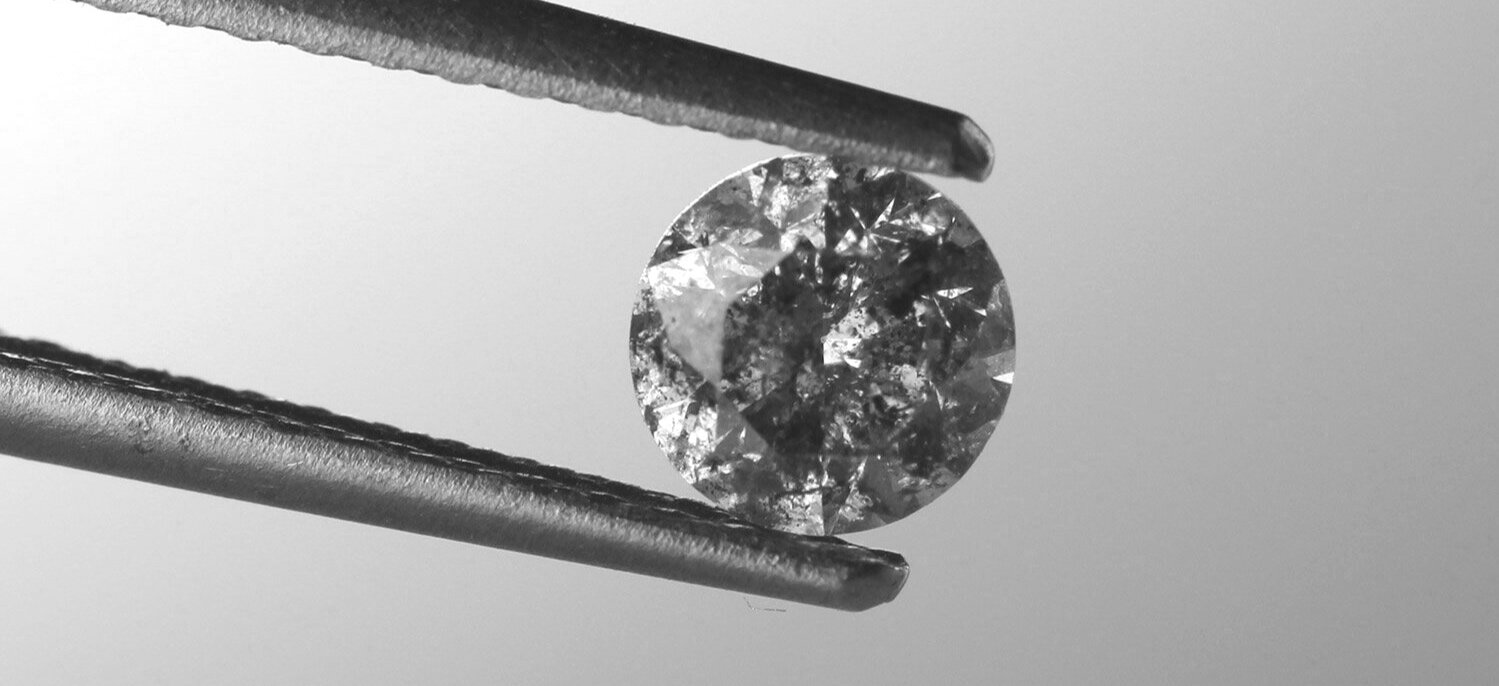
The stunning salt and pepper diamond above is great example of a growing trend for gems who's natural inclusions, crackles and changes in colour are celebrated for their unique beauty.
We sourced the diamond for an engagement ring who's wearer wanted a classic design with a twist and did not want an idealised idea of perfection but a truly individual representation of love.
There will always be a place for the sparkle of a white diamond but now stones such as bi coloured tourmalines, grey diamonds, opals, moonstones and the myriad of sapphire colours give brides to be more choice for an engagement ring that embodies their tastes and lifestyle
In fact the brilliance of classic white diamonds often compliments the rougher beauty of an imperfect stone.
We currently have a small selection of grey diamonds to view and can source a wide variety of beautiful gems, please visit our bespoke page for more info.
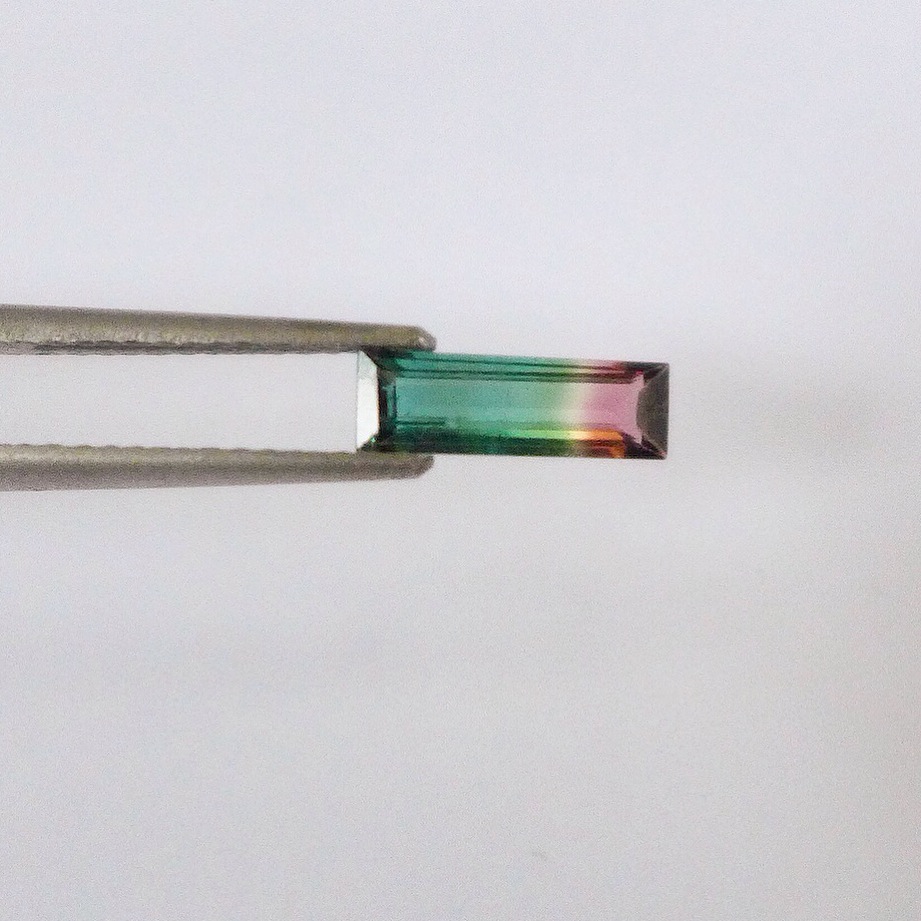
Tourmaline is famous for its vivid changes of colour.

An irregular cut ruby with beautiful inclusions.


What are the choices for Mens wedding rings
Tips and inspiration for guys looking for Wedding and Civil Partnership bands. Wedding band shapes and the different precious metal options.
Mens wedding rings
Guys If you have just begun to look for a wedding ring or civil partnership bands and are a bit lost with what is best for you or just with the idea of wearing jewellery in general, this guide will quickly run through the basics to start you off on your search. We will also give a little more info on unique or bespoke designs for those a bit further down the line, to show that although when it comes to wedding jewellery many think of the bride there are plenty of choices for grooms as well!
Before you start you can view our range of wedding rings. And for help finding your finger size view our printable Ring sizing chart.
Choosing The Metal
Our choice of metal is often quite instinctive. It could be the traditional colour of yellow gold that you are drawn to, alternatively we really like natural un plated white gold whilst the copper tones of rose gold are becoming increasingly popular with guys. For others it may be the metals properties that resonate, for instance the strength and durability of Platinum make it a great choice for a ring you will wear everyday.
Many couples choose to have their rings made in the same precious metal creating a nice link between a pair of bands even if the designs are very different.
If you like to keep your colours matching one point to keep in mind is this is something you will be wearing everyday, if you wear a watch or other pieces of jewellery such as cufflinks or think you may do in the future consider what colour these will be and if they go with your ring.
You can find out more in our Guide to precious metals
Deceiding on Shape
The most common rings a man will be shown when he first walks into a jewellers are Court, D Shape and Flat. These classic profiles only differ slightly but having decided on the width and depth of the band and whether to go for a polished or matt finish they can work with a surprisingly wide range of personal styles. All three are popular because they are simple and understated which is what many men want.

Court shape rings have a domed outer and slightly curved inner with straight sides. The rounded inside makes for a comfortable fit with a luxurious weighty feel.
D-shapes are named simply because their profile is that of a capital D on its side. These bands have a classic curved outer whilst the flat inside means the ring is not quite as heavy as a court and keeps the band a bit flatter to the finger
Flat Bands are the first port of call for those looking for a clean modern look. The flat surface area can also be used to show off texturing. Our flat bands have a curved inside for comfort.
As with the choice of metal a visual link can be made between partners bands by choosing the same ring profile even if widths are not the same.
Alternative mens wedding rings
There is no need to feel constrained by tradition many men want something unique that represents their personality.
Often the only way to achieve this is to commission a bespoke design. One off pieces may seem intimidatingly expensive but it doesn't have to blow your budget. A quick chat with a jeweller can determine what kind of materials and processes would be needed to achieve your ideas and budget. Our Bespoke page has more information.

This bespoke textured wedding ring was made using an oversized 9ct white gold band. The marks were created with a specially made punch.

These matching bands are cast from the same unique mould.
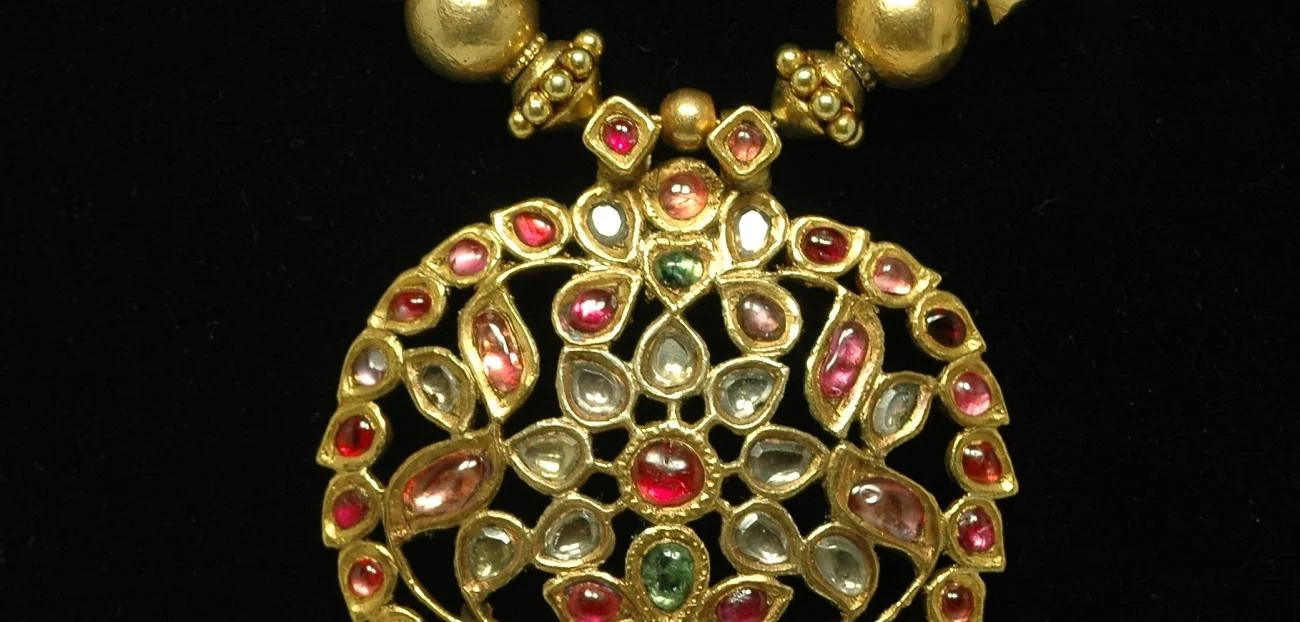
The Art of Kundan
Discover the ancient technique of Kundan setting.

Kundan setting
I recently visited the V&A to see Bejewelled Treasures, the Al Thani collection. The exhibition presents jewellery made on the Indian subcontinent or inspired by India dating from the early 17th century to the present day.
There are many show stopping stones on display which can be traced back to the treasuries of ancient Indian kingdoms one necklace which stands out in my memory is a string of giant uncut spinels with amazing colour and translucence.
Often the famous pieces also provide an interesting snapshot of Indian history, the exhibition is excellent at pointing out changing fashions and how traditional Indian styles were mixed with foreign cultural ideas from the Persian speaking elite in the Mughal court to western influences centuries later. Pieces which were owned by important figures reveal political upheaval such as the emblematic tiger head from the gold throne of Tipu Sultan, who fiercely resisted the British, after he was defeated the East India Company ransacked his palace destroying or taking many precious artefacts.
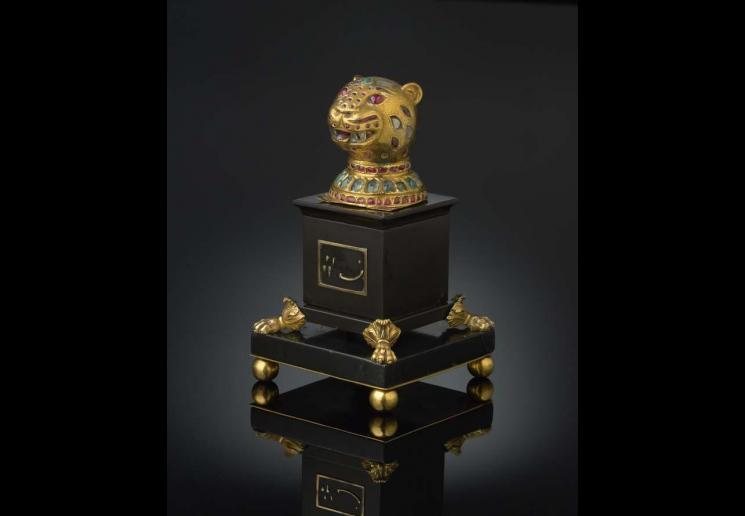
The tiger head finial from Tipu Sultans throne.
However this isn't really a review of the show, as a jeweller I not only enjoyed the visual inspiration I love to see the incredible metal smithing techniques, part of the fun is trying to work out how something was made or a certain look achieved.
One ancient technique caught my eye in particular, known as Kundan setting.
Kundan which means highly refined gold is still practised in Jaipur, Rajasthan. It was developed in the 16th century by Mughal court goldsmiths and combines the setting of stones with pure gold foil and beautiful enamel work. Enamel had not been used in the sub continent before and was probably introduced from Europe.
I hadn't seen this form of setting before it is a clever way to set irregular shaped stones into often intricate patterns.
Once the main body of the piece of jewellery has been made, stones are placed into a settings much like a beval setting however with a beval setting the walls of the mount must perfectly match the shape of the stone, where as Kundan set stones have gaps in between the irregular gem and mount. Pure gold foil is skilfully worked in to these gaps and pressed down to secure the gem.
The result can be stunning I was interested to read that Kundan jewellery is still an integral part of the traditional bridal outfit. And that traditional styles of jewellery are experiencing a revival.
It will certainly be something I keep in mind when designing in the future and I really do want to have a go at it myself.
The exhibition featured an excellent video shot in workshops in Mumbai and Jaipur showing a step by step process of the making of Kundan earrings, you can view the V&A s video below to get a better idea of the skill involved.
Bejewelled the Al Thani Collection runs to 10th April 2016 visit the V&A for more info.
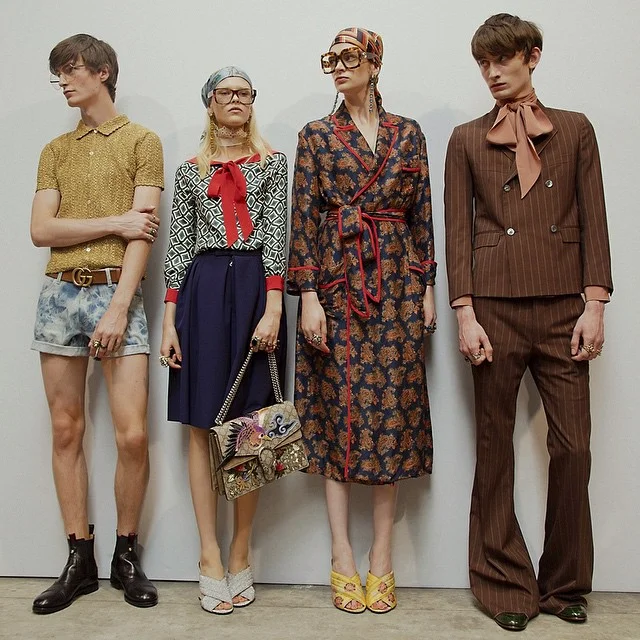
Vintage Trends 2016
For SS16 fashion houses have gone back in time to source inspiration for their runway shows. Sarah Bennett owner of vintage boutique Make Do & Mend takes a look at the key trends.
This year, fashion houses have gone back in time to source inspiration for their runway shows. Our friend Sarah Bennett owner of vintage boutique Make Do & Mend takes a look at some of the key trends for Spring / Summer 2016.
Sarah has an expert eye for beautiful vintage pieces, her shop in Brixton is bursting with vibrant clothes and accessories. We love sustainable fashion and Sarah also offers on site alterations and workshops.
Many of the styles highlighted in this blog can be recreated with pieces from Make Do & Mend.
VINTAGE REIGNS ON THE CATWALK IN 2016

There is a noticeable Vintage theme for the up and coming year in fashion proving vintage is not only here to stay but influencing the designers of today. From bold 60s prints to Victorian lace, the catwalk has covered it all. We have picked some of the on trend spring themes and shown you how to recreate these looks using some statement vintage pieces from our Make Do and Mend Boutique.
Victorian Lace


Elie Saab SS16
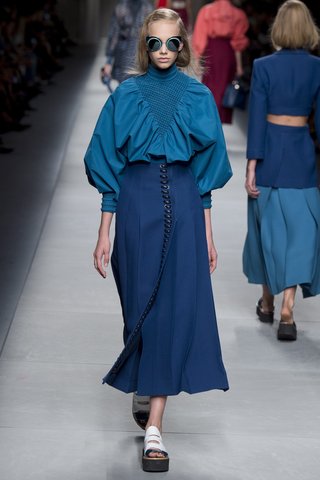
As seen on the catwalk this year from Erdem, Valentino, Elie Saab and Zimmerman. Blouses and dresses with high necks, ruffles, lace, pintucks and billowing sleeves are all having their moment. Pair one of these blouses with a modern leather skirt for the an upto date office look. Skinny jeans or leather trousers will take you through the weekend for a more casual take on this 19th century revamp.
Print and Pattern
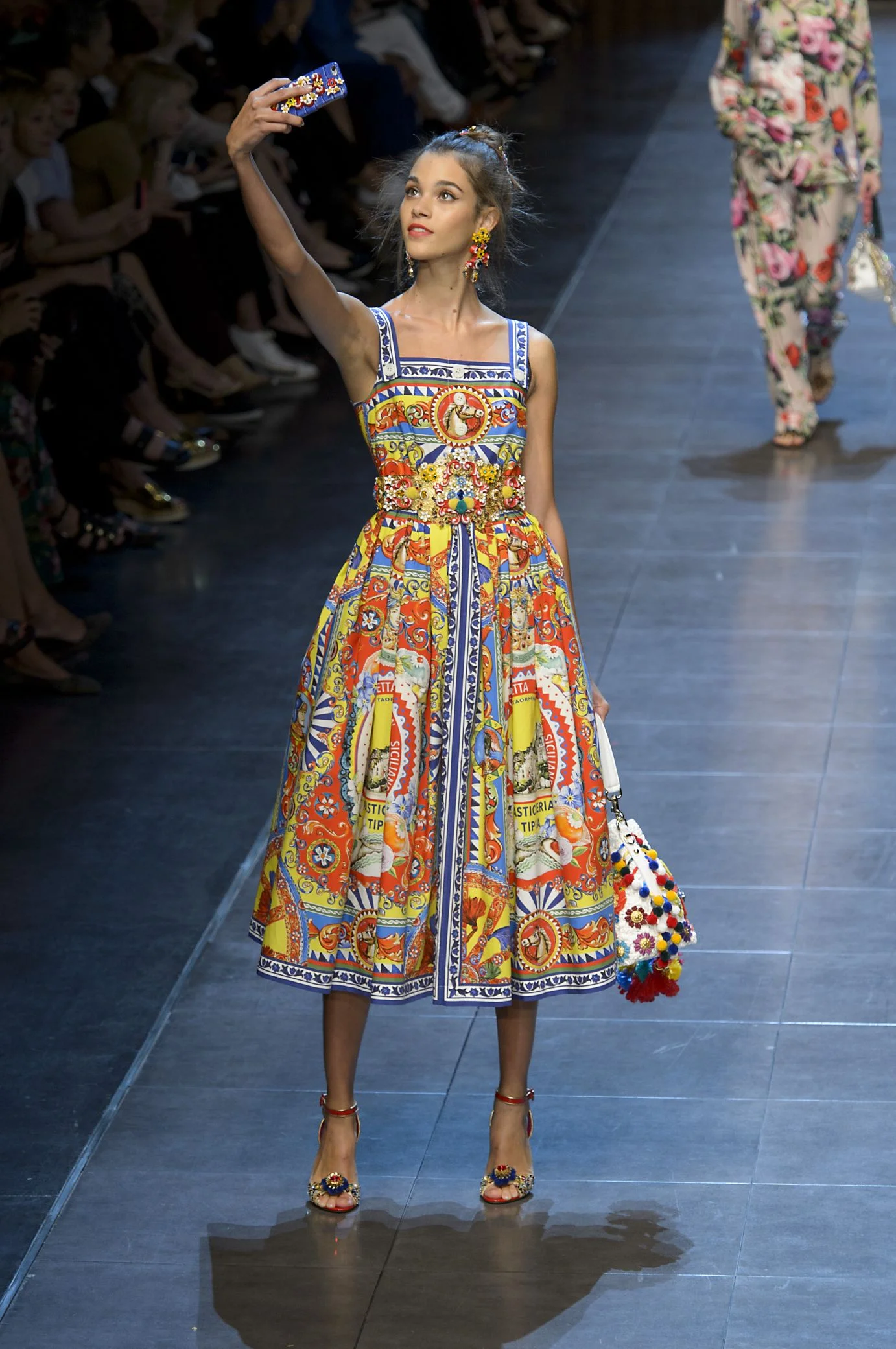
Many fashion houses have been inspired by the fabulous prints of the past. From Orla Kielys fun 60s prints on everything from jumpsuits to blouses, paired with cute 60s pinafore dresses. To the 1950s floral prints and bright colours of Dolce and Gabbana's Amalfi coast inspired collection. We are so excited by these trends and seeing such bold references to decades gone by. We love print and pattern in our store.

Pretty in Pink
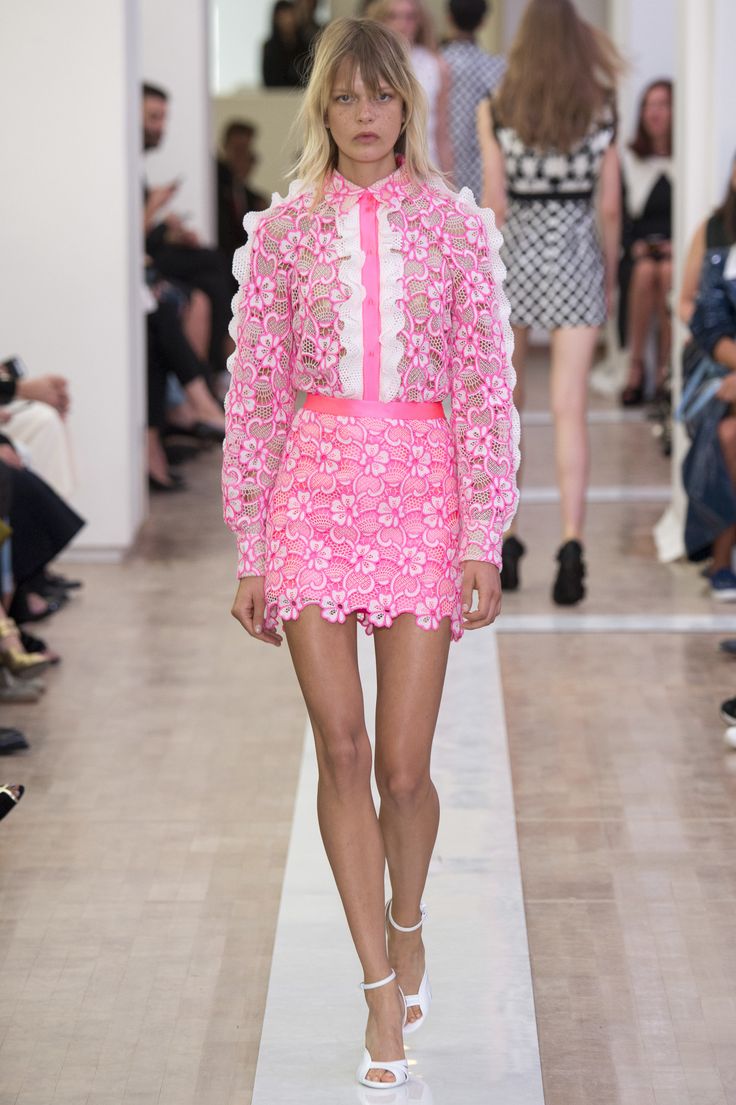
Floaty, ethereal, lacey and feminine. This flattering trend in those dusky, powdery hues is here to stay for another year. Seen on pretty much all the catwalks from Stella McCartney, Gucci, Caroline Herrera, Chloe and Alexander McQueen to name a few! Flattering and perfect for a spring wedding or occasion, this is a staple for any girls wardrobe so why not make yours a vintage one! A classic cut such as this 1950s lace dress is a timeless piece that shows vintage can hold its own time and again.

This article originally appeared on www.makedoandmendclothing.com
Diamonds: A Guide To The 4 Cs
Gain confidence when choosing a diamond for an engagement ring or bespoke piece of jewellery with our guide to diamonds and the 4Cs.
What are the 4Cs?
Choosing a diamond for an engagement ring or bespoke piece of jewellery can be a little daunting and there is a lot of confusing information out there. This quick guide will give you a simple understanding of how a diamond is valued/graded so you can choose that all important stone with confidence.
Diamonds are the hardest naturally occurring material known to man, the name originates from the Greek word Adamus meaning unconquerable. Created deep within the earth over 1 to 3 billion years ago each diamond is unique and there are many factors to consider when valuing each one. To determine a stones quality jewellers use what is known as the 4Cs, an internationally recognised grading system that accurately measures Cut, Carat, Colour and Clarity.
Here is our low down on the 4Cs.
Diamond Cut
Of all the 4 Cs the Cut can have the greatest influence on a stones quality. The cut refers to the shape of the diamond but is graded on how well proportioned the stone is. It is the job of a skilled stone cutter called a lapidary to take a rough mined diamond and precisely shape and polish it into a beautiful gemstone.
How symmetrical the stone is cut determines how well its facets interact with the light. As light travels into the stone it is bounced from facet to facet and reflected back out of the stone which creates the flashes and sparkles diamonds are famous for.
The most popular shape is the round brilliant cut which has 58 facets and is designed for maximum sparkle, other shapes such as ascher or emerald are cut to play with the light differently and allow you to see further into the stone.

Diamond Carat
A diamonds weight is measured in Carats, one carat is the equivalent of 0.2 grams, or a 1 carat round stone would be roughly 6.4mm. A carat can be sub divided into a hundred points, so even very small stones can be weighed. When viewing diamonds a jeweller may describe a stone below 1 carat by its points alone so a 0.30 carat diamond would be called a thirty pointer.
Larger stones are rarer and it can be a natural instinct to go for the biggest stone however it is a combination of all of the 4 Cs that determines a diamonds value.
Diamond Colour
Most diamonds are graded on a colour scale from D - Z, D being the most valuable because it is completely absent of colour which enhances the crisp pure characteristics of the stone. The amount of colour present increases very gradually through the scale and the subtleties in colour between two grades can be impossible see to the untrained eye.
Naturally occurring coloured diamonds known as Fancies are found in pink, green, blue, brown, champagne and yellow but are very rare. Rather than being graded on the absence of colour they are graded on the intensity of their colour. I particularly like brown and champagne diamonds which compliment gold or platinum beautifully.

Diamond Clarity
A Diamond is formed deep within the earth when Carbon is exposed to extreme heat and preassure. This natural process means characteristics called inclusions (internal flaws) or blemishes (external marks) are present within the stone.
A diamonds clarity in measured when viewed under 10 x magnification, how many inclusions can be seen, their size and position all affect its clarity rating. All diamonds contain flaws but a diamond whose inclusions are to small to see under magnification is considered flawless and is extremely rare.

Gaining a little understanding of the 4 Cs can be very helpful but it’s important not to get too hung up on any one characteristic, finding the best balance between all four that your budget will allow will result in a great stone.
And if white diamonds are not for you, take a look at our guide to their rustic counterparts, What are Salt and Pepper diamonds?
You can find more information on commissioning a hand crafted piece from us on our bespoke page.
A Guide to Precious Metals
In this quick guide we explain what different precious metals are available when choosing a wedding or engagement ring.
Choosing The Right Metal For You
Precious metals are the most beautiful choice for jewellery due to their colour and versatility.
If you’re thinking of buying an engagement ring, commissioning a bespoke piece of jewellery or want one of our existing designs made in a different metal this quick guide will take you through the range of possible precious metals to choose from and give a little info on the characteristics of each metal.
Yellow Gold
Gold has a heritage unrivalled by any other metal and is still the most popular choice for wedding and engagement rings today.
Golds natural colour is a vibrant yellow, pure 24 carat gold is too soft to be used for jewellery so it is alloyed or mixed with other metals to strengthen it. The amount of gold present will also affect the colour and weight of the finished piece. In the UK we mainly make gold jewellery in 9 and 18 carat. 18 carat is 75% pure gold mixed with other metals which perfectly combines the beautiful gold colour with enough strength to stand the test of everyday life. The metal alloys can also be chosen for their colour which is what enables us to create jewellery in rose gold and white gold.
Rose gold
Rose gold gets is beautiful pink tone from the presence of copper as an alloy. The warmth of rose gold looks stunning against all skin tones whether a matt finish or polished to a high shine. Rose gold is the perfect compliment to white diamonds and can give a simple design a vintage twist.
It is also becoming more and more popular with guys, the subtle copper tones referencing an industrial aesthetic.
White gold
White gold naturally has a warm almost champagne tone from the mixing of yellow gold with palladium, which we think is perfect as it is. A lot of jewellers will rhodium plate white gold to give it a brilliant white shine but we prefer to keep things natural. The understated elegance of white gold works brilliantly with champagne diamonds and other coloured stones.
Platinum
Platinum is very pure, it is composed of 95% platinum mixed with iridium, ruthenium and palladium which makes it an incredibly dense, strong metal, perfect to set stones safely in delicate settings. Its natural white colour also compliments white diamonds for a simple chic look.
Silver
We use sterling silver which is hallmarked 925 this means 92.5% is pure silver mixed with 7.5% of other metals usually copper to strengthen the metal whilst keeping the beautiful colour. Silver is a lovely material to work with for its versatility. However silver should not be used to set expensive stones for this very reason, its softness means that it can be easily damaged which can lead to the setting becoming loose.
Deciding between these beautiful materials can be an exciting choice as each one will give the same design a very personal look and feel. If you’re searching for an engagement ring or special piece of jewellery check out our bespoke jewellery page and our guide to diamonds.
Lost Wax Casting
Take a look behind the scenes at how Daniel hand carves many of his designs. Creating jewellery using the lost wax casting process.
How We Hand Carve Our Jewellery
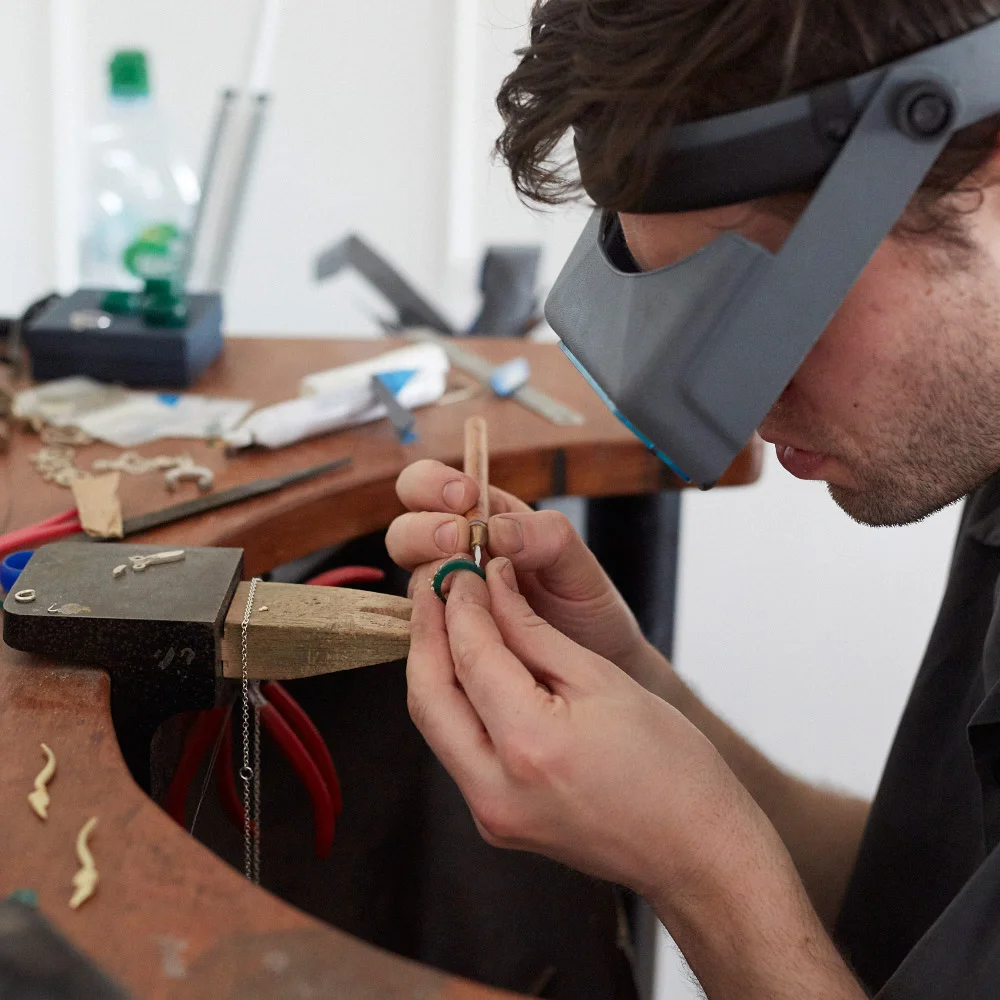
We are very proud that all our jewellery is hand made using traditional skills. In this blog we take you behind the scenes of our London workshop to highlight a key process used to make many of our designs especially the more intricate ones this is the lost wax casting process.
But what is Lost wax casting? Using the Deep Sea Diver pendant from the Into The Deep Collection as an example here is a step by step guide to the process.
First sketches are made to work out design and proportions.
Daniel carves each design from wax using hand tools and scalpels.
Details and amendments are made by melting the wax with a heat pen.
The piece begins to take shape
The finished wax master is used to create a mould.
A mould of the master is taken from which precious metal castings can be made.
The caste metal (in this example silver) is rough and must be cleaned and polished.
A series of files and tools are used to clean up the casting.
Any components such as chains are soldered on before a final polish.
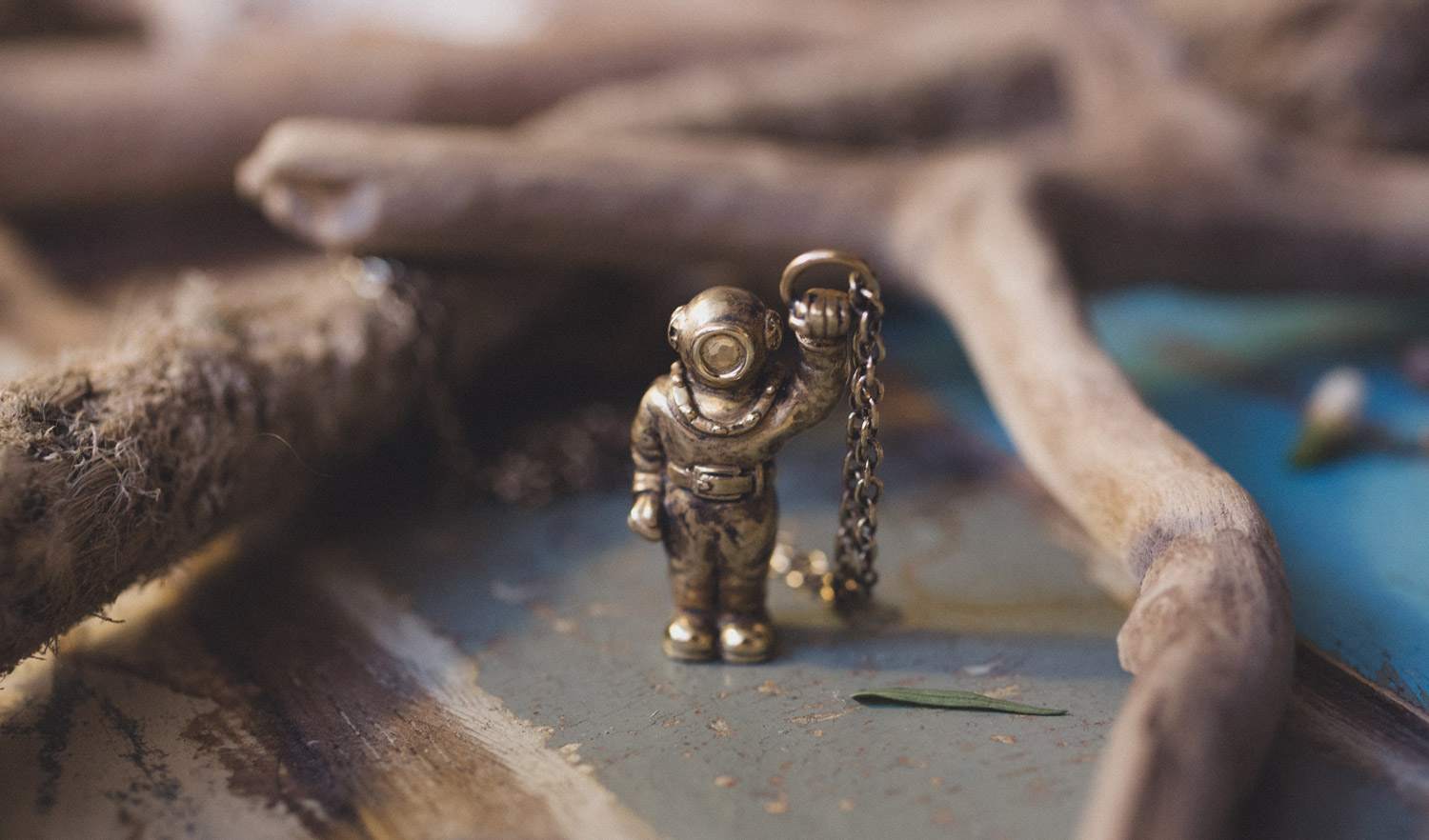
The Diver necklace is now finished.
Manmade Craft Fair
Im really excited to be taking part in Manmade. A craft fair celebrating men who make.

I am excited to be taking part in Manmade this June. Manmade is a craft fair for male designer makers, although men are obviously very well represented in all professions and this is true of the jewellery industry, craft fairs are an exception with blokes running stalls a rarity. Manmade aims to be a fun way showcase male designers and maybe encourage some more. (expect lots of beards).
Im busy making stock at the moment and will be revealing a couple of new designs for the first time at the event. It will be held in The Truman Brewery on London's Brick Lane on the 12th and 13th June and is free! there will also be workshop displays, talks and a bar. So pop down and say Hi if you're in the area.
Manmade is a collaboration between Crafty fox, Etsy UK and textile designer Mr Wingate.
You can find out more by clicking Here to go to Crafty Fox's website.
Manmade 12th &13th June
The Old Truman Brewery (F Block - G4 & G5, Entrance via Ely's Yard),
91 Brick Lane, E1 6QL, London.
FREE ENTRY